
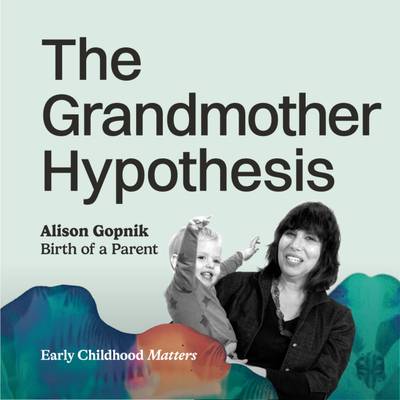
Most species don't have grandparents. Humans do. Why? In this final episode of season one, developmental psychologist Alison Gopnik explores a strange feature of human evolution, and what it reveals about childhood, caregiving, and why raising children was never meant to be a job for parents alone.
Shownotes:
- Much of today's conversation draws on Alison Gopnik's bestselling book The Gardener and the Carpenter, in which she argues that the purpose of parenting is not to shape children into a predetermined ideal, but to create the conditions in which children can learn, explore and flourish.
- The episode explores the Grandmother Hypothesis, the evolutionary theory that humans' unusually long post-reproductive lifespan evolved because grandparents helped raise children and pass knowledge across generations.
- Alison discusses anthropologist Michael Gurven's research on hunter-gatherer societies, which shows that complex skills such as hunting take decades to master. His work helps explain why older adults—and especially grandparents—play such an important role in passing knowledge from one generation to the next.
- Many of the ideas discussed build on anthropologist Sarah Blaffer Hrdy's groundbreaking book Mothers and Others, which argues that humans evolved as cooperative breeders, relying on parents, grandparents and other alloparents to raise children.
- Alison also reflects on anthropologist Polly Wiessner's work on the "joking relationship," suggesting that grandparents don't just preserve traditions, they also help children imagine how the world could be different.
Hosted on Acast. See acast.com/privacy for more information.