

Nieuwste afleveringNIOD Rewind Episode 50 - The Restitution of the Diamond of Banjarmasin09 okt · 33 min
NIOD Rewind Podcast on War & Violence
NIOD Rewind podcast
Geef deze podcast je waardering
The NIOD REWIND podcast presents interviews with scholars on the history and study of mass violence, war and genocide.

Wist je dat tijdens de Tweede Wereldoorlog er een compleet verscholen dorp bestond in Nederland? De bosrijke omgeving rondom de Gemeente Epe kwam goed van pas kwam bij de onderduik van Joden, verzetsstrijders en anderen die zich verborgen moesten houden voor de nazi’s.
In deze aflevering duiken Anne van Mourik (NIOD), Catharine Aretakis (Universiteit Utrecht) en Epenaar Willem Veldkamp in het oorlogsverhaal van de omgeving van Epe. Hoe kan het dat er in Epe een ‘goede geest voor verzet’ was? Wat moesten deze mensen op het spel zetten? En, als we wat uitzoomen en Epe vergelijken met andere regio’s in Nederland: waarom verschilde de mate van verzet tussen verschillende lokale gemeenschappen? En wat leren geschiedenissen als die van Epe ons over de rol van sterke lokale gemeenschappen in het afremmen van massaal geweld?
Afbeelding tegel: Het Verscholen dorp, Pas-Opweg, 8076 Vierhouten. Gelegen nabij Vierhouten in de provincie Gelderland. Wikimedia Commons.
Fotocredits: Lodewijk Booij, Mariette Veldkamp
Language:This is a special one-off episode in Dutch. All upcoming episodes will be back in English. A big thank you to Catharine Aretakis for being so flexible and for joining us in Dutch, which is not her native language.

What is happening in Tigray? In this episode Anne van Mourik speaks with Teklehaymanot (Tekle) Weldemichael (University of Manchester) about the strong evidence that Ethiopia committed genocide in Tigray, and the (lack of) academic freedom to publish on it.
The war between Ethiopia and Tigray began in 2020 and saw widespread atrocities, including mass killings, systematic rape, starvation, and the destruction of civilian infrastructure. How to analyse this mass violence? Did the ceasefire of 2022 truly end the violence? How became the bodies and especially wombs of Tigrayan women sites of violence during the conflict? And what kind of challenges do scholars face, who want to publish on what is happening in Tigray?
Image: Protestor holding sign in support of women in Tigray 2021, CC BY 2.0 Wikimedia Commons.

Are perpetrators of mass atrocities really “monsters”? Or are they, in fact, normal people, like us? Anne van Mourik and Lucy Gaynor interview Professor Alette Smeulers (University Groningen), who argues that those who commit extreme violence are often far more ordinary than we would like to believe. We discuss Alette’s research - which looks at many cases including the Holocaust, the Rwandan Genocide, Apartheid in South Africa, and military dictatorships in South America - and ask: what patterns emerge? Do different contexts produce different types of perpetrators, such as “fanatics”, “masterminds”, and “followers"? Does social media, in our modern age, act as a kind of fanatic infrastructure, creating spaces like the manosphere, or even enabling perpetration? What is the role of “strongmen” like Donald Trump, Vladimir Putin, and Benjamin Netanyahu, in the perpetration of atrocities? How do other leaders, like NATO Secretary-General Mark Rutte, play a part in normalising violence?
Photo: Adolf Eichman in Ramle Prison1961 (Wikimedia Commons)
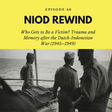
In the first episode of Season 7, Anne van Mourik talks with Susie Protschky (Vrije Universiteit Amsterdam) to explore the question of perpetrator trauma in the aftermath of the Dutch–Indonesian War. They look at how members of Indies diaspora and former combatants in the Netherlands live with (post-)war trauma, including those implicated in violence and oppressive regimes.
What does perpetrator trauma mean? How does trauma show up in everyday life and in political discourse? How is it sometimes used to shape narratives of victimhood that aim to mitigate questions of responsibility?
As the conversation unfolds, Susie and Anne end up circling a familiar knot: why focus on perpetrator trauma at all? Are we in danger of losing sight of historical violence and suffering by shifting attention to memory politics and postwar narratives? Or is this precisely where the political work of history continues to unfold?
Image: Burial at sea of Dutch soldier, 1950 (NIMH)

NIOD Rewind Episode 45 - Under German Occupation: Europe 1939-1945
09 sep 2025 · 51 min
In this episode, Anne van Mourik speaks with historian Tatjana Tönsmeyer (University of Wuppertal) and Peter Romijn (NIOD and UvA) about Tönsmeyer’s groundbreaking book Unter deutscher Besatzung: Europa 1939–1945 (Under German occupation: Europe 1939-1945). The book offers a Europe-wide account of life under Nazi occupation told from the perspective of the occupied, exploring fear, deprivation, and everyday strategies of survival. How did a climate of fear affect daily life in occupied Europe? Why is it not useful to talk in terms of ‘collaboration’ and ‘resistance’? And what can the book teach us about how to understand and respond to situations of occupation today?

NIOD Rewind Episode 44 - The End of Empires and a World Remade
25 jun 2025 · 43 min
Did European colonialism truly end in the 20th century, as we often assume? In this episode Anne van Mourik (NIOD) speaks with Martin Thomas (Exeter University) about his book The End of Empires and a World Remade: A Global History of Decolonization (Princeton University Press). He argues that decolonization was not just the transfer of power from colonizers to the colonized, but a global, often violent process that forged new alliances, reshaped international connections, and left behind enduring colonial legacies. In this episode we ask: How to rethink decolonization? If empires were so powerful, military, politically, economically, why and how did they collapse? And how is colonial violence different than violence in non-imperial spaces?
Photo: Civilian are pushing a military jeep. 1 August 1962. Wikimedia Commons.

NIOD Rewind Episode 43 - Hunger as a Weapon of War & Genocide
26 mei 2025 · 47 min
In this episode, Anne van Mourik (NIOD) sits down with famine scholars Alex de Waal (Tufts University) and Ingrid de Zwarte (Wageningen University & Research) to discuss how hunger can be used as a political-military instrument of power—from the Dutch Hunger Winter of WWII to Sudan, Yemen, Ukraine, and Gaza today.
Was starvation in the Netherlands during WWII intentional? What role did food play in Dutch colonial violence in the Indonesian War of Independence? And in the present: What are Israel’s objectives in starving Palestinians? Why is the international community failing to act—even when famine unfolds in full view of the world?

NIOD Rewind Episode 42 - 80 Years of Collecting War
07 mei 2025 · 45 min
Exactly eighty years ago, in the midst of the liberation’s chaos, the NIOD (then the RIOD) was founded with a clear mission: to document Dutch experiences of the Second World War. In this special anniversary episode, Anne van Mourik speaks with Jaap Cohen, Eveline Buchheim, Uğur Üngör, and Arvid de Raaij about eighty years of collecting memories, experiences, and stories. They reflect on NIOD’s urgent beginnings, its expansion to collect information about conflicts such as Indonesia’s War of Independence and the Yugoslav wars, and the ideas and challenges of documenting more recent atrocities, from Syria’s civil war to the Yezidi genocide. Why is collecting testimonies of war and genocide so vital? Why does it still matter just as much today? And how to collect digital sources about war and violence, such as the X-posts on the Ajax-Maccabi riots in Amsterdam in 2024?
Image: Loe de Jong, 1950 (NIOD archive)

In the first episode of a special NIOD Rewind series called Flash, Anne van Mourik speaks with historian Dr. Anne-Lise Bobelijk (NIOD) about how president Trump and presidentPutin are exploiting World War II history to support their current political strategies. In this short 10-minute episode, we explore how the past is being reshaped to influence the present, from Trump’s comments on US-Soviet cooperation to Putin’s manipulation of history to justify his war in Ukraine.
Photo: 2nd Lt. William Robertson and Lt. Alexander Sylvashko, Red Army, shown in front of sign [East Meets West] symbolizing the historic meeting of the Soviet and American Armies, near Torgau, Germany on Elbe Day, the day Soviet and American troops met at the Elbe River (April 1945). Wikimedia Commons.

NIOD Rewind Episode 40 - Early Postwar Tourism to Former Concentration Camps
23 sep 2024 · 34 min
How has American tourism to Nazi concentration camps influenced the ways in which people remember the Holocaust and Nazi atrocities? In this episode, Anne van Mourik (NIOD) sits down with Leonie Werle (Freie Universität Berlin) to explore this question. As early as 1948, American tourists started to visit German concentration camps, with magazines even promoting Germany as the land of ‘Bach and Belsen’. What did this early postwar tourism to the camps look like? Is it a form of dark tourism? Why were the camps often experienced as disappointing by American tourists? And why do people so often compare the Holocaust and concentration camps to present-day events, such as the COVID-19 pandemic or other crises?
Credits image in logo: Visitors view a photomural of corpses piled on the ground in the newly liberated Bergen-Belsen concentration camp at the "Lest We Forget" exhibition at the Library of Congress.
Photographer: John Mueller
Date: 1945 June 30

NIOD Rewind Episode 39 - The Paradoxes of Fascist Internationalism
05 jul 2024 · 28 min
In recent years, several far-right parties espousing nationalist, anti-immigrant, and Eurosceptic ideas have garnered significant support. Despite their nationalist ideologies, these contemporary far-right movements have demonstrated a surprising capacity for international cooperation. Anne van Mourik interviews Martin Hamre, a historian of fascism at the Freie Universität Berlin about this topic. What are some earlier examples of fascist internationalism? How did fascist ideas spread through international conferences and cooperation in the 1930s? What insights does Hamre's research provide for understanding the contemporary European far right?
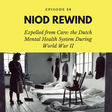
Why did a relatively high number of psychiatric patients die in Dutch psychiatric institutions during World War II? Anne van Mourik interviews Eveline Buchheim (NIOD) and Ralf Futselaar (NIOD and Erasmus University Rotterdam) regarding their book, ‘Expelled from Care’ (Uit Zorg Verdreven). In Nazi Germany, psychiatric patients were killed as part of the regime’s ‘euthanasia program’, which aimed to eradicate individuals considered genetically and economically ‘undesirable’. Did this National Socialist ideology also contribute to the excess mortality among the Dutch psychiatric population? What was life like for patients and staff working in psychiatric institutions during the war?
Credits image: Collection Museum van de Geest | Dolhuys, Haarlem

How do researchers navigate field research in conflict-affected societies? In this episode of NIOD Rewind on War and Violence, we explore the challenges and opportunities of conducting field research. Host Anne van Mourik engages with researchers Solange Fontana and Lauren Gould, both with extensive experience in conflict-impacted societies. Why are first-hand experiences important when researching war and violence? What does the increasing shift to remote warfare mean for scholars seeking to conduct fieldwork? When doing fieldwork, how do you manage security? And how to deal with the emotional toll the work might take?

How to use ego-documents in research on war and violence? In this episode Anne van Mourik speaks with Clara Dijkstra (Cambridge University), and Carlijn Keijzer, Afke Berger and Milan van Lange (NIOD) about this question. The term ego-documents pertains to the realm of the individual, encompassing both the people who create these personal records and the content they document. Besides, as historical sources, ego-documents have a lot to offer beyond the individual’s perspective. This episode delves into a topic central to the NIOD: the intricate connection between ego documents and research, discussing some of the (im)possibilities, pitfalls, and opportunities of using such sources in documenting and studying the history of war.

In this episode Anne van Mourik speaks with visual historian Kylie Thomas (University College Cork and NIOD) about the meaning of the medium of photography for thinking about the Holocaust. How can photographs intersect with how we perceive this history? What happens when images relating to the Holocaust, for example of Anne Frank, become ubiquitous? In this conversation, Kylie and Anne focus on the work of the Austrian-born Jewish photographer Dora Kallmus (1891-1963). How do her photographs of slaughtered animals function in the aftermath of the Holocaust?
"Visual Narratives of Catastrophe" is a quote from Lisa Silverman, Art of Loss: Madame d’Ora, Photography and the Restitution of Haus Doranna, in: Leo Baeck Institute Year Book, 60, 1 (2015).
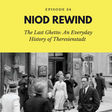
NIOD Rewind Episode 34 - The Last Ghetto: An Everyday History of Theresienstadt
30 mei 2023 · 42 min
Laurien Vastenhout and Anne van Mourik speak with historian Anna Hájková about her landmark work The Last Ghetto: An Everyday History of Theresienstadt (Oxford University Press). What was life in the Theresienstadt ghetto like, and what does this case study tell us more generally about human behaviour under extreme conditions? How should we (re)define the concept of agency in the context of Holocaust and Genocide Studies (and beyond)? And what is the meaning of kinship and family ties in times of crisis?

Wat kun je lezen in de dagboekcollectie van het NIOD? Aan de hand van dagboekbeschrijvingen vertelt collectiespecialist Michiel Wilmink over de levens van mensen in de Tweede Wereldoorlog. We horen over de date-ervaringen van dwangarbeider, over een politieman die Jodenarresteert en over hoe het dagelijks leven voor sommigen doorging – terwijl het voor anderen drastisch veranderde. Wil je een dagboek schenken of komen inzien? Neem dan contact op het NIOD.

How do Kurdish women struggle to voice themselves in contemporary Turkey? Anne van Mourik speaks with Marlene Schäfers (Utrecht University) about her book ‘Voices that Matter: Kurdish Women at the Limits of Representation in Contemporary Turkey’ (University of Chicago Press, 2022). What does it mean to ‘have a voice’ in a context of protracted political violence? To what extent do Kurdish women’s gaining voices lead to empowerment? And how does Marlene, as a scholar specialized in women’s struggle for voice, view the current protests in Iran?
Photo: Braxton Hood. Kurdish singer (dengbêj) Gazîn performing via mobile phone, Wan, Turkey, 2011.

Why does the Jewish Council phenomenon remain such a controversial topic? Anne van Mourik speaks with Laurien Vastenhout on her new book ‘Between Community and Collaboration: “Jewish Councils” in Western Europe under Nazi Occupation’ (Cambridge University Press). What were differences and similarities between the ‘Jewish Councils’ across occupied Western Europe? What room for manoeuvre did the Jewish leaders have, and what impact did local factors have on the form and function of these Councils? We talk about the importance of comparative analyses, socio-historical conditions in Western Europe during the war, and many other themes.
Photograph by Johan de Haas, reproduced by kind permission of the De Haas family and the NIOD

What was the Indonesian revolution (1945-1949) like as a lived experience? Anne van Mourik speaks with historians Abdul Wahid, Yulianti and Roel Frakking about their new book Revolutionary Worlds: Local Perspectives and Dynamics during the Indonesian Independence War, 1945-49 (Amsterdam University Press). With the book, Indonesian and Dutch researchers bring together two historiographical traditions to shed light on the complexities of the revolutionary war. What did this collaborative project yield? And what does it mean that the book’s primary focus lies with the period between 1945 and 1950? What stories emerge when the consequences of the revolution for different communities locally are centered?
Image: ‘The guerilla’s are defining their tactics’ (Gerilya Mengatur Siasat) 1964. Painting by S. Sudjojono, Presidential palace, Bogor.
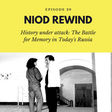
How is memory weaponised in the Russian-Ukrainian war? In this episode, Anne van Mourik and Thijs Bouwknegt talk with historian Nanci Adler. How does she, as a scholar of transitional justice, reflect on this conflict? What is the significance of Vladimir Putin’s shut down of the Russian human rights organisation Memorial? And how does this feed in to Russia’s repression of its Stalinist history?

NIOD Rewind Episode 28 - Heritages of Hunger: Memory is the Past made Present
24 nov 2022 · 27 min
How does the current Russo-Ukrainian war impact the memory of the Holodomor – the man-made famine in 1932-33? How do the recent Spanish memory laws impact present-day discussions of the Años del Hambre, the years of hunger during the Francoist dictatorship? And how are memories of the Scottish Highland Clearances (1750-1880) evoked in connection to Black Lives Matter demonstrations? In this episode Marta Baziuk (Holodomor Research and Education Consortium), Laurence Gourievidis (Université Clermont Auverne) and Miguel Ángel del Arco Blanco (Universidad de Granada) speak about the functioning of famine pasts in the present.
The episode is made by Anne van Mourik (NIOD) and Lindsay Janssen (Radboud University) in the context of the research project Heritages of Hunger.
Photo: Replica of the 'Bitter Memories of childhood' sculpture, located in the Holodomor Memorial Parkette (2018), Toronto. This photo was taken on 6 March 2022 – after the Russian invasion of Ukraine (24 February 2022). Someone has placed flowers of Ukraine's national colours (yellow and blue) in the arms of the statue.
Photographer: Charley Boerman

Why do humans fight? Anne van Mourik speaks with Sinisa Malešević (University College Dublin) on his new book (published by Cambridge University Press). Drawing on interviews with former combatants, Sinisa explores how violence operates in the context of face-to-face actions. What motivates human beings to fight? To what extent do people fight for reasons of self-interest? And in which contexts is fighting more likely to happen?

NIOD Rewind Episode 26 - Bones of Contention: The Vietnam-American War
06 sep 2022 · 40 min
In this episode Anne van Mourik and Dat Nguyen talk with Tam Ngo and Sarah Wagner on the remains of the war dead of the Vietnam-American War (1957-1975). Following the end of the war, the commemoration and identification of the fallen and missing-in-action soldiers from both the Vietnamese (North and South) and American sides remains a contentious issue. With Tam and Dat researching respectively the North- and South Vietnamese perspectives and Sarah the U.S. perspective, this episode approaches the topic from three different angles of the war. What is the contention about? How are the bones used for necro-political and necro-governmental agendas over time?

NIOD Rewind | Episode 25 - What is 'Violence'? Debates and Directions
29 aug 2022 · 29 min
Ever since its founding an important theme within NIOD research has been 'violence': the perpetration of violence, the legacies of violence, and the multilayered experience of violence and its effects on individuals, communities and nations.
To renew thinking on the core question of what constitutes violence and how to study it, in June 2022 the NIOD organised, together with the Netherlands Institute of Advanced Studies (NIAS) a workshop on the question ‘What is violence? Debates and Directions’. In this episode, scholars Sinisa Malesevic, Tatjana Tönsmeyer, Avi Sharma and Ton Zwaan discuss how they use the concept of violence in their work. How to address less visible kinds of violence, such as long-term pollution or climate change, which have the potential to kill entire populations and destroy entire regions of the world? How can research on violence draw attention to institutionalised inequalities and exploitation? And who actually decides what counts as violence – in the past but also in the present and future?

Het NIOD beheert meer dan 2500 meter archiefmateriaal: van een op sigarettenvloei geschreven dagboek uit een Japans interneringskamp in de Tweede Wereldoorlog tot aan archiefmateriaal verzameld en opgemaakt gedurende het Srebrenica onderzoek in 1996-2002. Hoe wordt deze bulk aan data opgeslagen en doorzoekbaar gemaakt? Anne van Mourik spreekt met Carlijn Keijzer, NIOD beleidsadviseur Collecties en Diensten. De totstandkoming van archieven is mensenwerk waarbij keuzes worden gemaakt over het bewaren en structureren van het materiaal. Wat betekent deze selectie en waardering voor welke geschiedenissen wel en niet uitgelicht worden? Hoe reflecteren bestaande machtsstructuren op welke verhalen in de archieven worden verteld en welke worden vergeten?
***
In de aflevering wordt verwezen naar: Ismee Tames, 'Digitale ontsluiting van het Centraal Archief Bijzondere Rechtspleging: Mogelijkheden en onmogelijkheden', Tijdschrift voor Geschiedenis 133 no. 2 (2020): 303 - 324.

Why was music key to anticolonial and antiracist cultural politics in interwar Paris? Anne van Mourik interviews Rachel Gillet on her new book At Home in Our Sounds: Music, Race, and Cultural Politics in Interwar Paris. In the aftermath of World War I, Black men and women participated in the Parisian cultural and political life via music. How could music function to build community and assert belonging? And how was it deployed to combat fascism and racism in the early 1930s?

NIOD Rewind Episode 22 - Born under a bad sign
11 apr 2022 · 32 min
In this episode of NIOD Rewind Anne van Mourik speaks with Ralf Futselaar about his inaugural lecture Born under a bad sign. The indelible Marks of Total War on Twentieth Century Lives (November 2021). Ralf warns against focusing too much on individual lives in historical narratives that suppose to ‘give history a face’. Instead, he advocates to investigate warfare and its long-term consequences on large, specific groups of people. What are the drawbacks of making history relatable by telling individual life stories to represent violent episodes? How can computational analysis of large data sets help us understand group effects of violent episodes of the twentieth and twenty-first centuries? Can such analyses further our understandings of the Dutch Hunger Winter, for example?
Photo: Collectie Fries Verzetsmuseum, Leeuwarden

How did Germany and the Netherlands deal with violent political groups of the 60s and 70s? How can we compare this with Dutch reactions to violent political groups? And how to understand current far right Alternative für Deutschland (AfD) politics? Anne van Mourik speaks with professor Jacco Pekelder about the dynamics of violence in Germany and the Netherlands in the long twentieth century. In 2021 Jacco got assigned as head of the Centre of Netherlands-Studies and in his work deals with the relationship between Germany and the Netherlands. What are his plans for future research?
In the interview, Jacco spoke about the film 'Buongiorno notte' (2003) directed by Marco Bellochio.
Picture: Rob Bogaerts/ Dutch National Archives/ Anefo
Gerelateerde podcasts
Alle podcasts → De Universiteit van Nederland PodcastUniversiteit van Nederland
 BNR Nieuws VandaagBNR Nieuwsradio
 NRC Onbehaarde ApenNRC
 Het SpreekuurErik Scherder, Leonard Hofstra, Brechje van Bladel / Corti Media & Quest
 Scientias PodcastScientias
 Let's go mentalNPO Luister / HUMAN
 Ondertussen in de kosmosde Volkskrant
 Zimmerman en SpaceHens Zimmerman
 Even DenkenUniversiteit van Nederland | Podimo
 Geef mij de ruimte podcastMitchell | Soulspark Media
 Geschiedenis van de NatuurkundeJan van Riswick, RU Nijmegen
 SterrenStofAnco van Hal